THE LAST PROTOCOL
THE LAST PROTOCOL
A cinematic environment study of a flooded city still operating after its inhabitants have disappeared.
A cinematic environment study of a flooded city still operating after its inhabitants have disappeared.
Speculative World-Building · Environmental Storytelling · Real-Time Cinematics
Speculative World-Building · Environmental Storytelling · Real-Time Cinematics
THE LAST PROTOCOL
A cinematic environment study of a flooded city still operating after its inhabitants have disappeared.
Speculative World-Building · Environmental Storytelling · Real-Time Cinematics
Project Overview
The Last Protocol is a speculative world-building and real-time cinematic study exploring how a story can be communicated through environment alone. I developed the narrative, mapped the viewer’s movement through five spatial chapters, and designed each scene to reveal evidence of abandonment, autonomous systems, and ecological transformation.
Using Unreal Engine, I explored level-design-inspired spatial planning, environmental composition, material development, lighting, volumetric effects, Post Process Volume, and Sequencer camera choreography. The result is a series of connected environments that function as both a cinematic journey and a study in real-time visual storytelling.
The Last Protocol is a speculative world-building and real-time cinematic study exploring how a story can be communicated through environment alone. I developed the narrative, mapped the viewer’s movement through five spatial chapters, and designed each scene to reveal evidence of abandonment, autonomous systems, and ecological transformation.
Using Unreal Engine, I explored level-design-inspired spatial planning, environmental composition, material development, lighting, volumetric effects, Post Process Volume, and Sequencer camera choreography. The result is a series of connected environments that function as both a cinematic journey and a study in real-time visual storytelling.
Project Type
Self-Directed Speculative Environment Study
Year
Summer 2025
Role
Narrative Development, Environment Design, Cinematic Direction
Tools
Unreal Engine, Rhino, Blender
Explorations
Level Design, Unreal Engine Sequencer, Materials, Lighting, Post-Process
Project Overview
The Last Protocol is a speculative world-building and real-time cinematic study exploring how a story can be communicated through environment alone. I developed the narrative, mapped the viewer’s movement through five spatial chapters, and designed each scene to reveal evidence of abandonment, autonomous systems, and ecological transformation.
Using Unreal Engine, I explored level-design-inspired spatial planning, environmental composition, material development, lighting, volumetric effects, Post Process Volume, and Sequencer camera choreography. The result is a series of connected environments that function as both a cinematic journey and a study in real-time visual storytelling.
Project Type
Self-Directed Speculative Environment Study
Year
Summer 2025
Role
Narrative Development, Environment Design, Cinematic Direction
Tools
Unreal Engine, Rhino, Blender
Explorations
Level Design, Unreal Engine Sequencer, Materials, Lighting, Post-Process
Narrative premise
What happens when a city’s infrastructure outlives the society it was designed to serve?
The project follows a cinematic descent from the flooded skyline into the city’s hidden interior, where the remains of human infrastructure begin supporting a new ecology.
What happens when a city’s infrastructure outlives the society it was designed to serve?
The project follows a cinematic descent from the flooded skyline into the city’s hidden interior, where the remains of human infrastructure begin supporting a new ecology.
Scene-development breakdown
Each scene moved from spatial composition to surface development, then into lighting, fog, and final atmospheric treatment.
01 Spatial Composition
Testing camera angle, scale, and structural rhythm.

02 Surface Development
Concrete, wet surfaces, environmental decay, and vegetation.
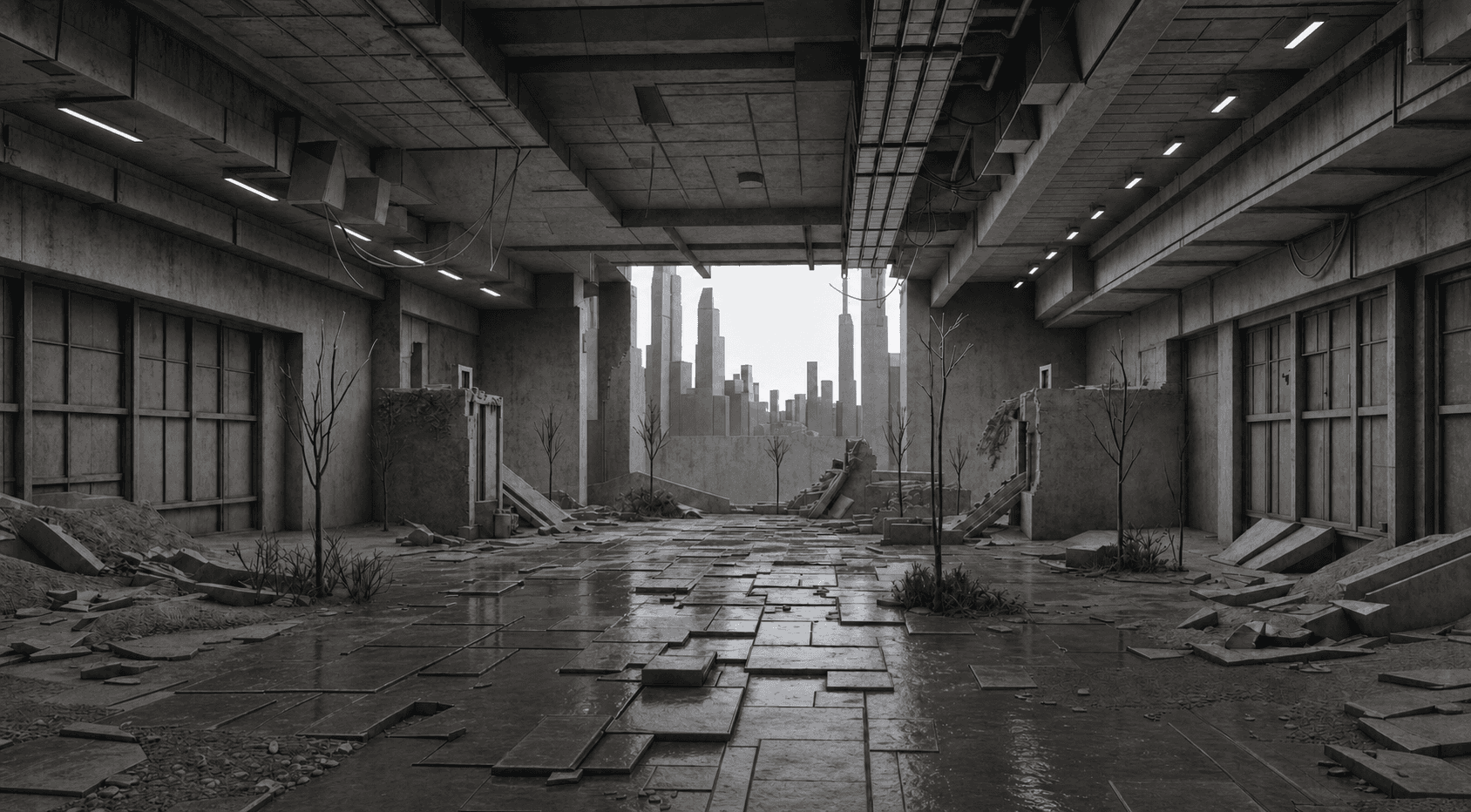
03 Final Atmosphere
Using Post Process Volume to shape the scene’s emotional tone.

Scene-development breakdown
Each scene moved from spatial composition to surface development, then into lighting, fog, and final atmospheric treatment.
01 Spatial Composition
Testing camera angle, scale, and structural rhythm.
02 Surface Development
Concrete, wet surfaces, environmental decay, and vegetation.
03 Final
Atmosphere
Using Post Process Volume to shape the scene’s emotional tone.
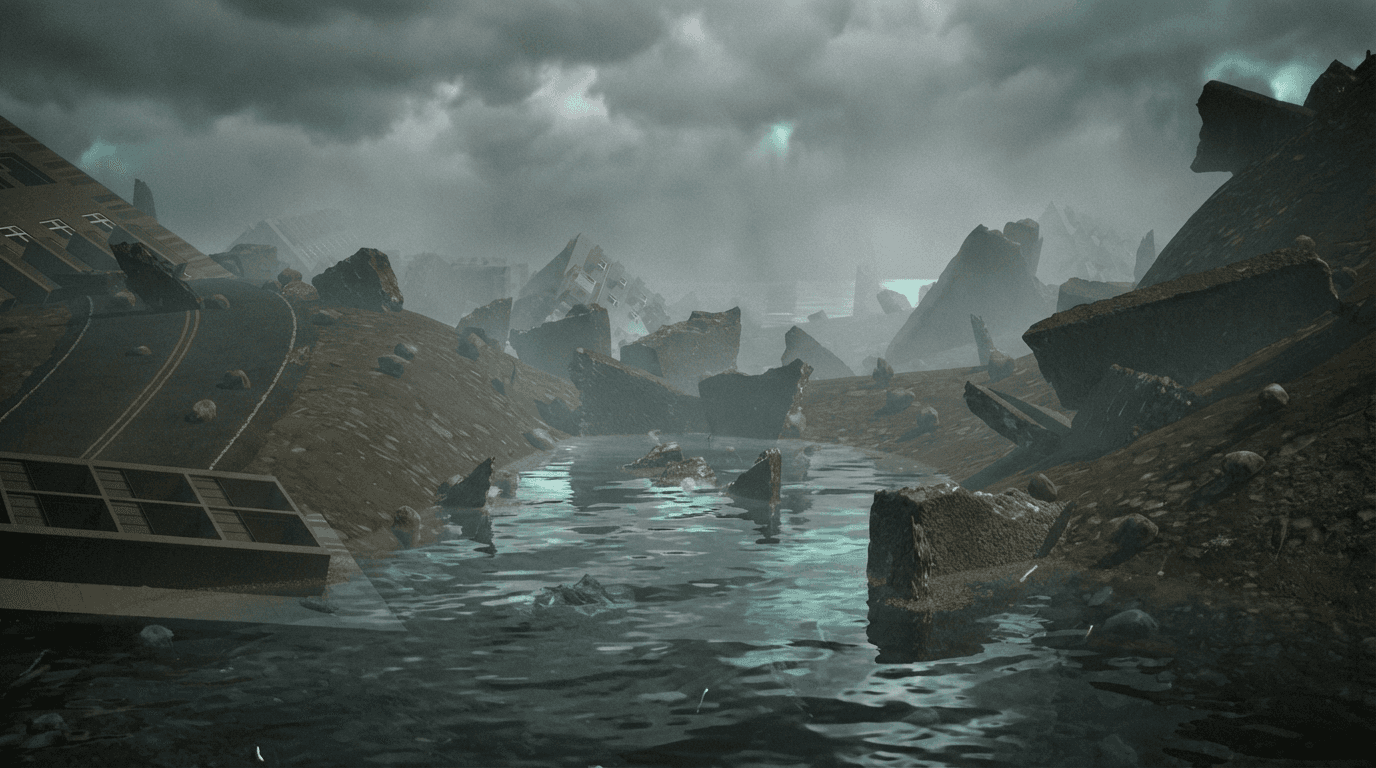
Cinematic Journey
The journey moves from the exposed skyline into the flooded ruins, before descending beneath the city.

Cinematic Journey
The journey moves from the exposed skyline into the flooded ruins, before descending beneath the city.
Animating the World — Unreal Engine Sequencer
I used Unreal Engine Sequencer to explore how camera movement could shape the pace and emotional tone of the environment. By testing changes in speed, elevation, framing, and direction, I developed a series of cinematic movements ranging from dynamic aerial traversal to slower atmospheric reveals.
01 — Guided Forward Movement
A forward-moving camera path leads the viewer deeper into the collapsed city.
02 — Dynamic Aerial Reveal
A dramatic, drone-like movement reveals the city's scales.
03 — Slow Push
A restrained forward movement builds tension through fog, light, and spatial depth.
Animating the World — Unreal Engine Sequencer
I used Unreal Engine Sequencer to explore how camera movement could shape the pace and emotional tone of the environment. By testing changes in speed, elevation, framing, and direction, I developed a series of cinematic movements ranging from dynamic aerial traversal to slower atmospheric reveals.
01 — Guided Forward Movement
A forward-moving camera path leads the viewer deeper into the collapsed city.
02 — Dynamic Aerial Reveal
A dramatic, drone-like movement reveals the city’s scales.
03 — Slow Push
A restrained forward movement builds tension through fog, light, and spatial depth.


